
Amplifier tuning is not something most people think about when comparing powered speakers. You will see wattage. You will see the driver’s size. You will see wireless features. What you usually will not see is how the amplifier was calibrated to work with the specific drivers and cabinet it is powering.
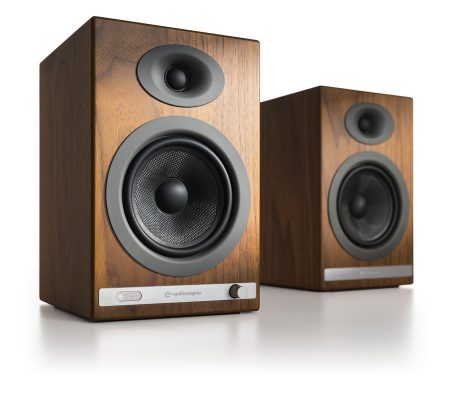
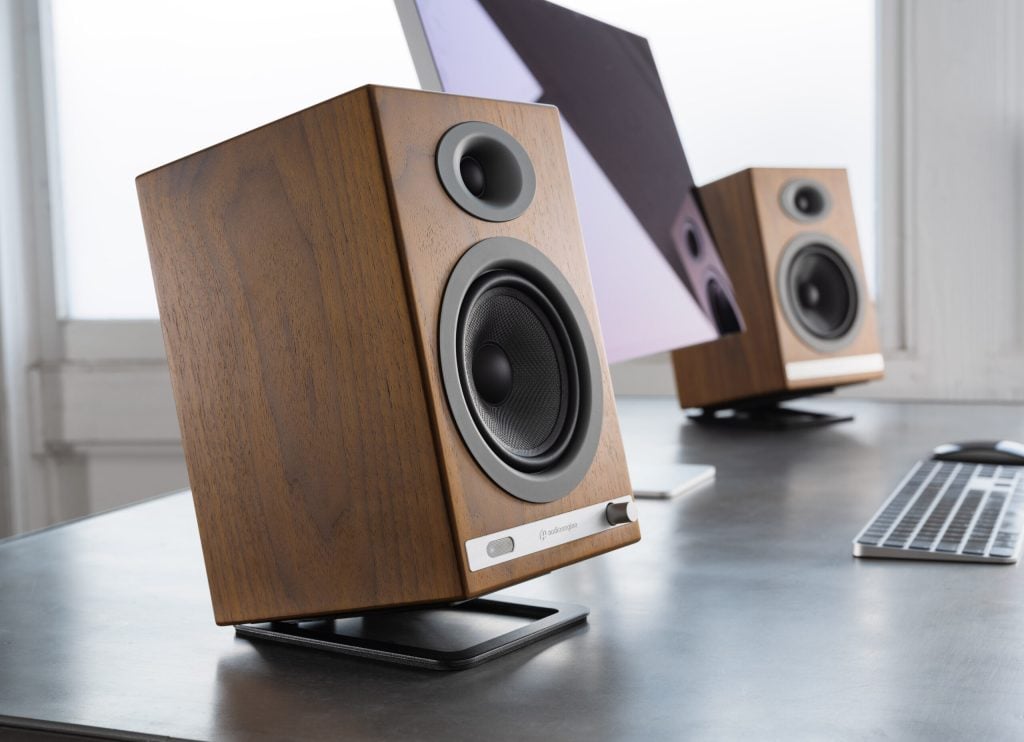
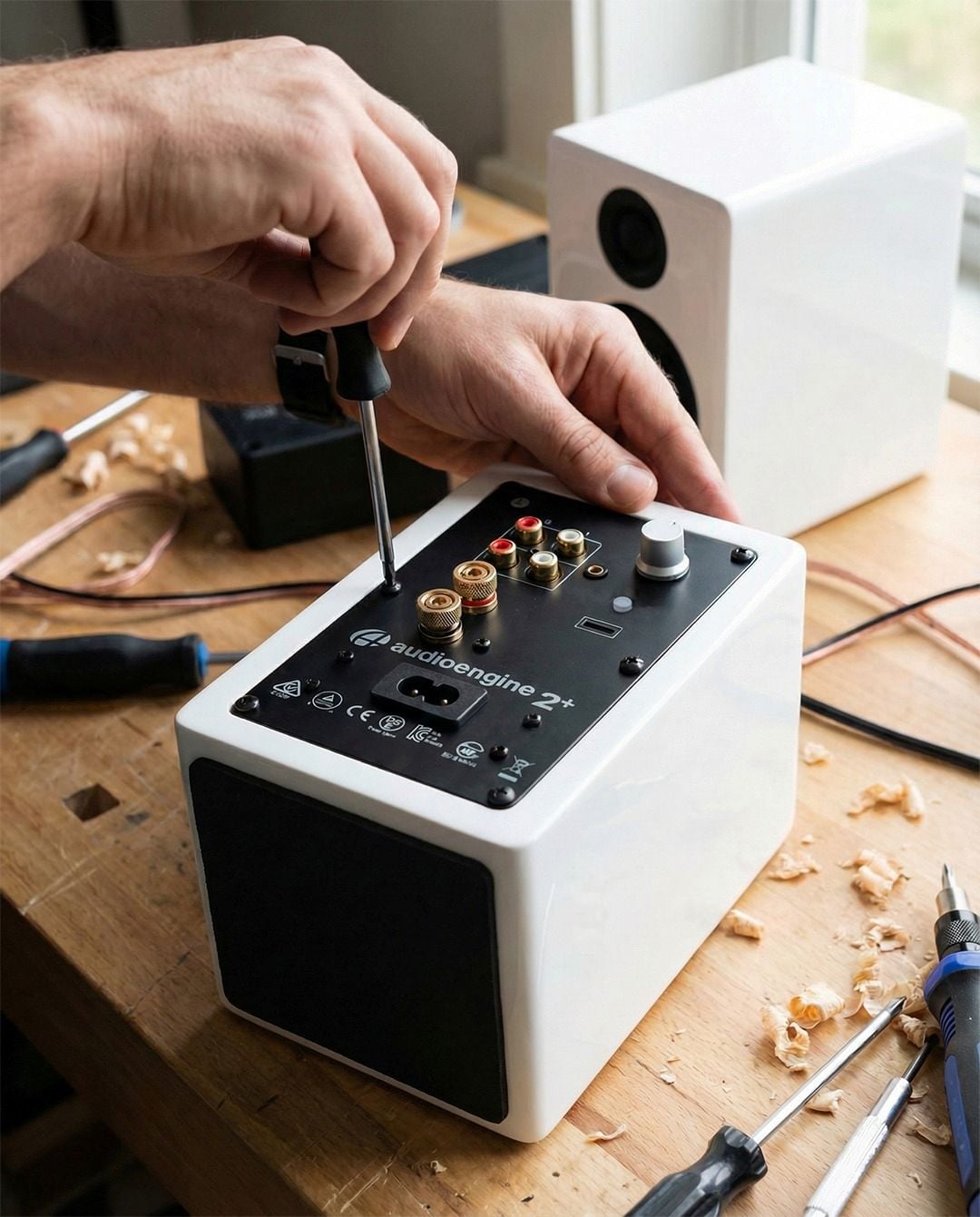
Before any Audioengine Home Music System enters full production, our US-based engineers hand-tune the amplifier stage to match the exact drivers, crossover network, and real-wood enclosure used in that model. That work is grounded in measurement, repeatability, and system-level engineering. It is also directly tied to how the product will perform in a real listening environment.
A powered speaker is a closed system
Inside a powered speaker, the amplifier, woofer, tweeter, crossover, and cabinet volume all interact. The amplifier does not simply deliver power. It controls cone movement, manages how the tweeter blends into the midrange, and determines how the system behaves during dynamic passages.
A speaker does not present a fixed electrical load. Its impedance changes across frequencies. Those changes affect current delivery, damping, and distortion behavior. If the amplifier is not properly matched, bass can lose control, vocals can shift forward or backward unnaturally, and distortion can appear earlier than expected at higher volumes.
Hand tuning allows our engineers to evaluate that interaction and refine the amplifier response, so the system remains balanced and stable.
Measurement first, listening second
The process begins with objective data. Engineers measure frequency response, total harmonic distortion, signal-to-noise ratio, dynamic headroom, and thermal stability. They test sustained output and short transient peaks that mirror real music rather than simple test tones.
Lower distortion and stable frequency response translate into clearer instruments and more accurate vocal reproduction. Careful control of the noise floor ensures quiet passages remain detailed instead of masked by hiss.
The crossover region, where the woofer transitions to the tweeter, receives particular attention. Slight differences in gain or phase alignment can alter imaging and midrange precision. Precise alignment keeps vocals centered and preserves separation between instruments across the stereo field.
Once measurements meet performance targets, controlled listening sessions confirm that the system maintains tonal balance and long-term listenability.
Gain structure and usable headroom
Power ratings alone do not determine performance. Music contains dynamic peaks that can far exceed average listening levels. If internal gain is not calibrated correctly, those peaks can push the amplifier into clipping.
During tuning, engineers adjust input sensitivity and gain staging to preserve usable headroom across typical listening levels. The system maintains composure as volume increases, allowing dynamic passages to remain clean rather than collapsing into harsh distortion.
This is especially important in compact Home Music Systems where driver excursion limits and cabinet volume must be carefully managed. Proper tuning ensures the amplifier supports the mechanical limits of the drivers instead of exceeding them.
Low-frequency control and damping
Bass accuracy depends heavily on how effectively the amplifier controls woofer movement. When a bass note ends, the cone must stop quickly and return to rest. Insufficient electrical damping can cause overhang, which reduces definition.
By refining output impedance and amplifier behavior relative to the woofer’s impedance curve, engineers improve low-frequency control. The result is bass that starts and stops cleanly, with definition and proportional weight rather than excess bloom.
Consistency across production
Once the amplifier and acoustic system meet performance benchmarks, that configuration becomes the reference for production. Component tolerances and long-term stability are reviewed to maintain repeatability from unit to unit.
Each Home Music System is built to meet the same acoustic target defined during tuning. That consistency ensures stable tonal balance, predictable dynamics, and uniform performance across production runs.
Engineering, not assembly
Many powered speakers rely on pre-configured amplifier modules integrated with minimal system-level refinement. Our approach treats the amplifier as part of the overall acoustic design. Cabinet material, driver composition, port tuning, and amplifier characteristics are evaluated together.
This integrated process reduces distortion, stabilizes frequency response, and improves dynamic behavior. The outcome is a coherent system that performs consistently at low background levels and during high-energy playback.
Amplifier hand tuning is not cosmetic. It aligns electrical performance with acoustic intent. By refining the amplifier to match the drivers and enclosure before production begins, every Audioengine Home Music System operates as a unified, engineered design rather than a collection of independent components.