

When people consider what shapes sound quality, they often focus on the obvious components, speakers, DACs, or amplifiers. But what powers those components matters just as much. Behind the scenes, one of the most important players in high-fidelity audio is the transformer, and in Audioengine gear, that means a toroidal transformer.
While the term sounds technical, its impact is easy to understand: toroidal transformers help your system deliver clean, stable power with virtually no interference. That translates directly into clearer, quieter, and more natural sound.
What Is a Toroidal Transformer?
A transformer is responsible for taking the voltage from your wall outlet and stepping it down to the levels your audio gear can use. The classic version, an E–I laminated transformer, uses a rectangular stack of metal plates and coils of wire. These work, but they have drawbacks: inefficiency, wasted energy as heat, and magnetic fields that spill into nearby circuits.
A toroidal transformer solves these problems by changing the shape. Instead of a rectangular core, it uses a donut-shaped core with wires wrapped evenly around it. This geometry creates several big advantages:
- Circular magnetic flux path: The magnetic field stays contained within the core instead of leaking into surrounding components.
- Higher efficiency: Less energy is wasted as heat, meaning more power goes directly into running your DACs and amplifiers.
- Lower noise and vibration: The symmetrical design produces very little hum compared to traditional transformers.
- Compact profile: Despite higher performance, toroids are often smaller and lighter, which allows sleeker product designs.
Think of it like comparing a drafty fireplace to a modern furnace. Both provide heat, but one wastes energy and creates a mess while the other is focused, clean, and efficient.

Why Transformers Matter in Audio
So why is this important for sound? Because everything your audio system does depends on power. Before the DAC converts a digital signal, before an amplifier drives your speakers, they both rely on the transformer to deliver stable, noise-free voltage.
If the transformer lets in interference, that interference shows up as hum, buzz, or distortion. Even if it isn’t obvious, it can blur the details of your music. A faint ripple in the power supply is like static on a radio, covering up subtle tones and textures.
Toroidal transformers fight this by keeping power clean, stable, and isolated. That gives sensitive audio circuits a foundation to perform at their best.
The Two Big Benefits of Toroidal Transformers for Listeners
There are two main reasons toroidal transformers make such a difference:
Reduced Electrical Interference Inside the Gear
Because of their circular design, toroidal transformers contain almost all their magnetic flux within the core. That means they don’t bleed electrical “waves” into nearby circuits, which is critical when those circuits are handling delicate audio signals.
Traditional transformers can introduce hum, especially noticeable at low volumes or during quiet passages in music. A toroidal transformer virtually eliminates that, allowing you to hear the space between notes, the fade of reverb, or the breath in a vocal track.
Protection Against Noise from the Outside World
Power from your wall outlet is never perfect. Other devices in your home, refrigerators, microwaves, and phone chargers, create noise that rides along the same power lines. A toroidal transformer is highly effective at rejecting that interference, acting as a buffer that shields your audio circuits from dirty power.
This is why toroidal transformers are often described as “quiet.” They’re not just mechanically silent; they keep unwanted signals from leaking into your music.
Sound Waves vs. Electrical Waves: A Simple Analogy
Sound travels as waves, and so does electricity. When multiple waves collide, they create ripples, distortion, and loss of clarity. Electrical interference acts the same way on audio signals; it overlaps with the music and distorts it.
By isolating the magnetic field and regulating the flow of current, a toroidal transformer keeps those extra electrical waves out of the picture. The result is smooth, ripple-free playback that preserves the integrity of the music.
Imagine listening to a delicate acoustic guitar passage. On gear with a standard transformer, you might not notice the faint hum behind it until you compare it with a system using a toroidal. Suddenly, the silence between strums feels deeper, and the strings sound more defined. That’s the power of clean isolation.
Why Audioengine Uses Toroidal Transformers
At Audioengine, our goal has always been to design products that sound great in everyday listening spaces, not just in theory, but in real homes and studios where interference is everywhere.
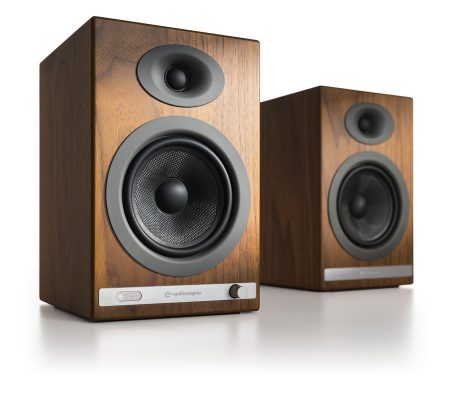
- In our Home Music Systems, the toroidal transformer ensures that the built-in DACs and amplifiers receive stable, noise-free power. This allows the system to deliver clean sound whether you’re listening via Bluetooth, USB, or analog inputs.
By incorporating toroidal transformers into our designs, we eliminate a significant source of unwanted noise before it reaches your speakers. That’s not an add-on or an upgrade, it’s built into the foundation of how we engineer our products.

Why Toroidal Transformers Matter for Your Music
The benefit of toroidal transformers isn’t about technical aspects of what you actually hear. Without transformer hum muddying the signal, details stand out. Instruments feel more distinct. Vocals remain clear. Even bass sounds tighter and more controlled because it’s not competing with stray noise.
For audiophiles, this translates into confidence: you know your system is revealing the music as it was recorded. For casual listeners, it simply means music that feels more alive and less fatiguing over time.
The Takeaway
Toroidal transformers may not be flashy, but they are one of the hidden reasons Audioengine products sound so good. By containing magnetic fields, rejecting outside interference, and delivering clean, stable power, they give DACs and amplifiers the foundation they need to perform at their best.
In short: they’re a quiet powerhouse, making sure you hear your music, not the noise around it.