
What’s the Difference Between Digital and Analog Amplifiers?
An amplifier takes a low-level audio signal from a source, such as a phone, turntable, or computer, and increases its power to drive your speakers.
Traditional analog amplifiers, commonly Class A or Class AB, use output transistors operating in a relatively continuous, or linear, manner to amplify that signal. What people often call digital amplifiers are actually Class D amplifiers. Instead of operating continuously, Class D designs switch their output transistors on and off extremely quickly to deliver power efficiently.
Here’s an important distinction: Class D doesn’t necessarily mean digital. A Class D amplifier can accept an analog signal, and an analog amplifier can reproduce music from a digital source through a digital-to-analog converter (DAC). For most listeners, the practical differences come down to efficiency, heat, physical size, and amplifier design.
The Advantages of Class D Amplifiers
Class D amplifiers have become increasingly popular in modern home audio equipment, particularly where compact size and efficient power delivery are priorities.
- 1. Greater Energy Efficiency
Class D amplifiers can achieve efficiencies of 90% or higher under favorable operating conditions. Because less energy is wasted as heat, they can deliver substantial output power while consuming less electricity.
- 2. Compact Design
Higher efficiency generally reduces cooling requirements. Manufacturers can build smaller amplifiers without sacrificing the power needed to drive compatible speakers. This makes Class D especially useful for desktop audio, powered speakers, and installations where space matters.
- 3. Less Heat
Class D amplifiers generally produce less heat than comparable Class AB designs at similar output levels. That can simplify thermal management and provide greater flexibility when designing compact audio equipment.
Considerations for Class D Amplifiers
Class D circuits require careful engineering to manage their high-frequency switching behavior. Poorly implemented designs have the possibility of introducing switching noise, electromagnetic interference, or distortion. Output filtering and speaker-load interactions also require attention.
Fortunately, modern Class D technology has advanced significantly. A properly engineered Class D amplifier can provide excellent fidelity, making it the same if not better than, analog amplification.

The Advantages of Analog Amplifiers
Analog amplifier designs have been used in home audio equipment for decades. Class AB remains a popular choice because it combines straightforward circuitry with excellent sound reproduction.
- 1. Proven Sound Quality
Well-designed Class AB amplifiers can produce extremely low distortion, accurate frequency response, and detailed musical reproduction. Their linear operation makes them a dependable choice for high-fidelity listening.
- 2. Established Technology
Analog amplifier circuits have been refined over many years. Engineers understand their characteristics, making it possible to achieve consistent performance through careful component selection and circuit design.3.
- 3. Straightforward Output Design
Unlike Class D amplifiers, conventional Class AB output stages don’t require high-frequency switching and its associated filtering. This provides designers with a different approach to managing noise and distortion.
Considerations for Analog Amplifiers
The main trade-off is efficiency.
Class AB amplifiers typically convert more electrical energy into heat than Class D designs. As a result, they may require larger heat sinks, more ventilation, and additional cabinet space. This doesn’t necessarily affect your listening experience, but it can influence the size and placement of your equipment.
Does Analog or Class D Sound Better?
This is where the discussion gets interesting. Analog amplifiers are sometimes described as warmer or more natural, while Class D amplifiers are characterized as cleaner or more precise. Those descriptions may reflect experiences with particular products, but they aren’t universal characteristics of either technology.
Amplifier class alone doesn’t determine sound quality.
Circuit design, power supply performance, distortion levels, speaker compatibility, and available output power all contribute to the final result. A well-designed Class D amplifier can outperform a poorly designed Class AB amplifier, and the reverse is equally true.
More importantly, the speakers themselves, their placement, and the listening environment often make a greater audible difference than the amplifier topology.
Which Amplifier Is Right for You?
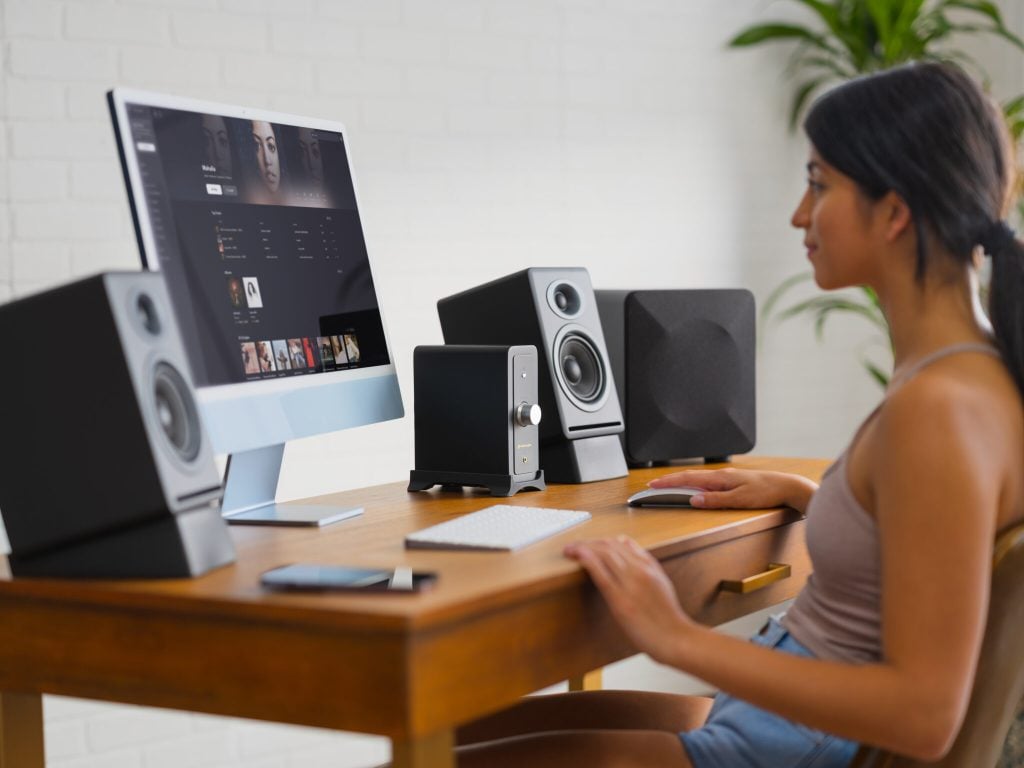
Rather than choosing based solely on whether an amplifier is analog or Class D, consider how you’ll use it. A compact desktop setup may benefit from Class D efficiency and smaller components. A traditional home stereo might use a Class AB amplifier for its established architecture and performance characteristics.
Neither approach has exclusive ownership of great sound. When comparing amplifiers, pay attention to their continuous power ratings, distortion specifications, supported speaker impedance, connectivity, and overall build quality. These details tell you considerably more about an amplifier’s suitability than its class designation alone.
Audioengine’s Approach: The Right Amplifier for the Job
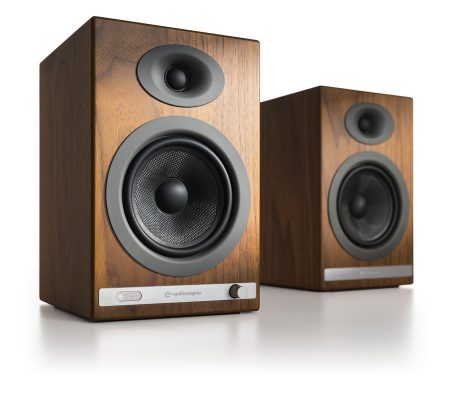
At Audioengine, we believe the best amplifier is the one that serves the music and the listening experience. That’s why we use different amplifier technologies across our products. Rather than committing to a single approach, we choose components and circuit designs based on each product’s performance goals.
Whether that means an analog Class AB design or an efficient Class D amplifier, our priorities remain consistent: accurate sound reproduction, dependable performance, and straightforward everyday listening. Both technologies can deliver outstanding music reproduction when they’re properly engineered and matched to the speakers they’re driving.
Ultimately, the best amplifier isn’t defined by whether it’s digital or analog. It’s defined by how well it reproduces the music you love.